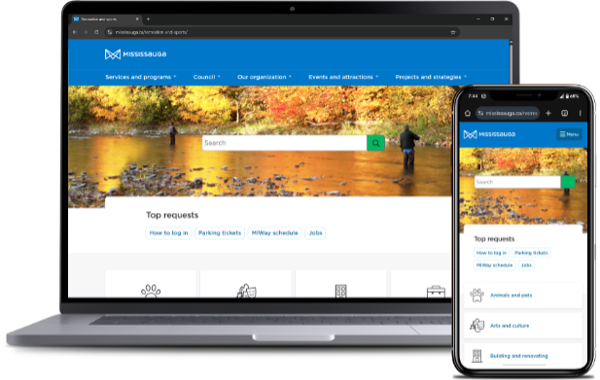
City of Mississauga website homepage (click image to view the project)
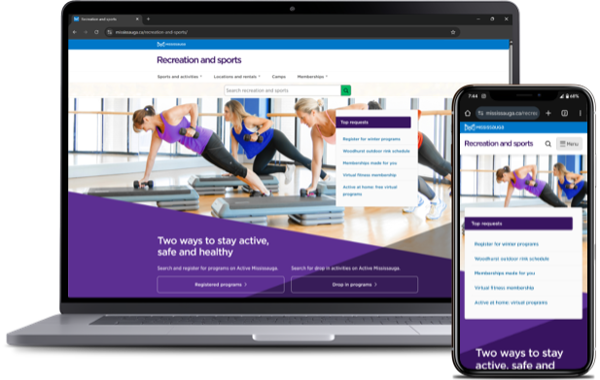
City of Mississauga Recreation homepage (click image to view the project)
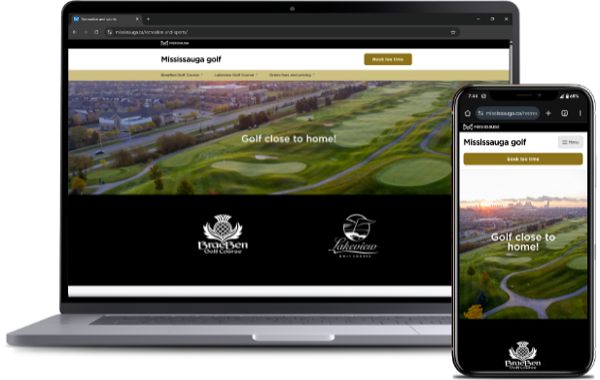
City of Mississauga Golf homepage (click image to view the project)
The project
A major overhaul of the City of Mississauga’s previous website. Early in the project I worked with the Recreation department as a liaison between them and the Digital Strategy & Experience designers and leadership team. Consulting on design, architecture, product feature sets, and business requirements.
Post launch I transitioned into the Digital Strategy & Experience team where I worked alongside the UX/UI design and web development teams to manage the new site. This also gave me the opportunity to work with leadership on gathering and reporting on site analytics. Working with a variety of other departments within the City on the design of their content was part of my responsibility as well.
The challenge
Although the previous website has served the City’s needs for a while it unfortunately started to become outdated over time. It had antiquated aesthetics and wasn’t user friendly nor accessible, falling short of the WCAG standards of that time. In addition there was also the challenge of easing existing users into new behavior patterns and aligning internal stakeholders to new content management workflows.
The solution
The Web Specialist, Digital Strategy & Experience Team kicked-off modernizing the website by gathering feedback from multiple internal stakeholders and city residents. The responses were gathered though in-person workshops, on location interviews, and via online surveys sent to select residents via email. This highly collaborative process revealed a variety of pain points and business requirement suggestions for the new website.
After analyzing the findings, issues and solutions were prioritized which then led to a lengthy, multi-phase development process with internal developers and external vendors. A mobile first design philosophy driven by data was adopted by the team and the following remedies were implemented:
Making the site flexible and responsive for mobile devices to expand usability and improve SEO performance.
Designing a cleaner, more intuitive user interface to reduce cognitive load.
Creating an evidence-based navigation scheme and information architecture that promotes low-friction discoverability ensuring a streamlined user journey.
Removing interaction barriers and ensuring equitable access by meeting WCAG 2.0 standards.
Developing and maintaining a confidential and proprietary design system and component library for better interface design consistency.
Modernizing the process for content edits and feature changes to improve the delivery efficiency of requests.
Implementing a user feedback and web analytics collection and review process to sustain usability standards into the future.
The newly redesigned website received praise from the public while opening up the website to a more diverse audience through the implementation of techniques and processes influenced by WCAG 2.0 standards. The user feedback included positive sentiments towards the intuitive navigation, structured and streamlined aesthetic, improved readability, and the much improved mobile user experience.
That said, websites need constant upkeep to maintain a high level of quality. The site is continuously improved and iterated upon, informed by user feedback and analytics. Through the unity of contemporary design philosophies and industry best-practices, the City website is now set on a path towards continued innovation and sustainability.